
 Unintended Consequences of Some Laws
Traffic laws are generally written with the goal of improving public safety. Legislators identify a danger, pass a regulation intended to reduce injuries or deaths, and hope the result is a safer roadway for everyone involved. However, not every law works as intended once it is introduced into real-world driving conditions. In some cases, regulations designed to solve one problem can unintentionally create new hazards for ordinary motorists. One such example is the “Move Over” law, which requires drivers to shift into the left lane when approaching emergency vehicles stopped on the shoulder of the road with flashing lights activated.
At first glance, the law appears sensible. Police officers, firefighters, ambulance personnel, and tow truck operators all work in dangerous roadside conditions. Vehicles speeding past only a few feet away create a constant risk of serious injury or death. Requiring drivers to move away from the shoulder is intended to provide emergency personnel with additional working space and reduce the chance of a tragic accident. The concept is understandable, and few would argue against protecting first responders who place themselves in harm’s way every day.
The problem, however, arises when lawmakers attempt to apply a one-size-fits-all rule to highly unpredictable highway traffic conditions. Modern interstate highways are often heavily congested, particularly major freight corridors such as Interstate 81 through Virginia. I-81 is well known for its dense concentration of commercial truck traffic, and under heavy traffic conditions, lane movement is not always possible without creating substantial risk to surrounding drivers.
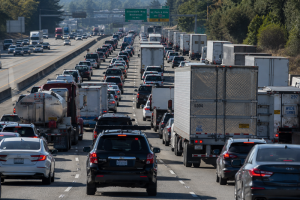
A recent experience while traveling northbound on I-81 demonstrated how dangerous this situation can become. Traffic that day was extremely heavy, with both passenger vehicles and semi-trucks filling the roadway. As commonly occurs on busy interstates, one tractor-trailer moved into the left lane in an attempt to pass another truck traveling only slightly slower in the right lane. The speed difference between the two trucks was minimal, resulting in traffic behind them becoming tightly compressed with little room for maneuvering.
Because large commercial trucks significantly limit visibility for drivers traveling behind them, motorists often cannot see developing hazards ahead until the last possible moment. In this case, the passing truck had not yet completed its maneuver and was unable to safely return to the right lane. Meanwhile, the truck being passed blocked the view of traffic conditions further ahead. Suddenly, drivers realized a Virginia state trooper was stopped on the shoulder conducting a traffic stop.
Within seconds, the situation escalated into near disaster. The truck in the right lane attempted to comply with the Move Over law by abruptly shifting into the left lane. However, three passenger vehicles were already occupying that lane while waiting for the passing truck to complete its maneuver. With virtually no escape route available, those vehicles were forced onto the shoulder to avoid being struck or crushed between large commercial trucks.
Fortunately, the truck driver quickly recognized the danger and moved back to the right lane, allowing the displaced vehicles to regain control and return safely to the roadway. No collision occurred, but the incident highlighted a serious flaw in how these laws function under real traffic conditions. A law intended to improve safety for law enforcement officers nearly caused a major multi-vehicle accident involving innocent motorists.
The reality is that lane changes on high-speed interstates are among the most dangerous maneuvers drivers perform. Sudden merging, especially in dense traffic traveling at 70 miles per hour or more, dramatically increases the risk of sideswipe collisions, chain-reaction crashes, and vehicles being forced off the roadway. While emergency responders unquestionably deserve protection, laws must also account for the practical limitations drivers face in heavy traffic situations where moving over may simply not be safely possible.
Many states do include language requiring drivers to move over “when safe to do so,” but the pressure created by strict enforcement campaigns and public messaging often leaves motorists feeling they must immediately change lanes regardless of surrounding conditions. That split-second decision can create panic reactions and unsafe driving behavior.
A more balanced approach may be needed. Rather than placing overwhelming emphasis on mandatory lane changes, greater focus could be placed on reducing speed significantly when approaching roadside emergency activity. Lower speeds provide drivers with more reaction time, reduce stopping distances, and lessen the severity of potential crashes. Combined with increased public education and improved traffic management techniques, such an approach could potentially protect both emergency personnel and the traveling public more effectively.
The intent behind Move Over laws is unquestionably honorable. Protecting police officers and first responders should remain a priority. However, lawmakers must also recognize that regulations designed in theory do not always translate safely into real-world highway conditions. Safety legislation should never create scenarios where drivers are forced into dangerous maneuvers that place additional lives at risk. The ultimate goal should be roadway safety for everyone, emergency personnel and motorists alike.