
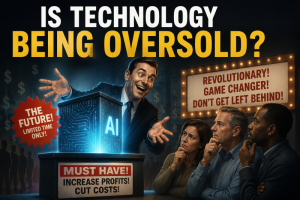
Is Technology Being Oversold?
Is technology being oversold? That’s a question few people seem to be asking. Evening news reports are full of stories about companies choosing to use AI to replace human workers. Restaurants, grocery stores, call centers, and many other businesses are embracing this new technology. The financial back offices of these companies have already calculated how much money can be saved. Yet no one seems to be asking whether the public is comfortable with the changes being made.
Many people have commented about their experiences dealing with AI-powered call centers. If you are calling about a simple issue, then perhaps AI is a good thing. But when the problem is more complex, AI is often not very helpful. What makes the situation even worse is that many AI systems make it difficult to reach a human being. There is nothing more frustrating than spending time dealing with a computer, only to find that you cannot speak with a person. In many cases, the call is even disconnected because the system lacks the ability to properly identify the real issue.
Another concern is that many of these early AI applications seem to be aimed at blue-collar and lower-level positions. The jobs being eliminated are often those held by middle- and lower-rung employees. Why isn’t any company attempting to use AI technology to reduce the number of executives? Just think of the hundreds of millions of dollars that could potentially be saved by eliminating executive positions. Consider the difficulties recently experienced by the Stellantis auto company, when its former CEO placed the future of the corporation on an aggressive EV strategy that turned into a financial disaster and nearly pushed the company into serious trouble.
Companies also are not talking about how they intend to maintain customer loyalty when customers have fewer opportunities to interact with human beings. Many of the jobs currently being replaced are positions that customers have traditionally dealt with on a personal level. Human interaction has long been a key part of customer service.
Is this race to embrace technology being driven primarily by corporate greed? The companies moving forward with these technological changes are generally not struggling businesses. Most are already profitable and are looking to push profits to levels not previously seen. What happens to a company like McDonald’s when the low-wage employees being replaced can no longer afford to buy its products? More than a century ago, Henry Ford understood the importance of making sure the workers who built his automobiles could also afford to own them. Otherwise, they might lose pride in their work and quality could suffer.
One example often cited is the use of red-light traffic cameras. These cameras were sold to the public as a way to create a safer driving experience. In reality, many became enormous profit centers for government entities that collected large amounts of money from drivers. The promises made before the installation of those cameras often failed to materialize. There are limits to what people are willing to tolerate, and this rapid rush to embrace technology could ultimately prove to be a mistake.