
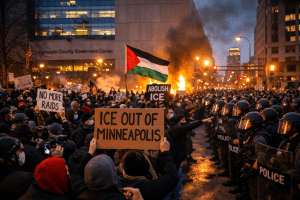
 The United States is currently experiencing heightened tensions surrounding immigration enforcement and public demonstrations. Recent events in Minnesota have intensified public debate and scrutiny of federal immigration operations. Some observers argue that certain individuals involved in protests traveled significant distances to the area and did so with the intention of confronting or interfering with ICE agents during an active operation. They contend that this context is often downplayed in public discussion, leading to differing interpretations of the incident and the motivations of those present. As a result, the situation has become part of a broader national conversation about protest activity, law enforcement authority, and the boundaries between lawful demonstration and direct interference with federal operations.
In January 2021, supporters of then-outgoing President Donald Trump gathered in Washington, D.C., to protest the certification of the 2020 presidential election results. The demonstration attracted a broad range of participants, including mainstream Trump supporters, political activists, and smaller groups affiliated with extremist ideologies. Law enforcement agencies later determined that some individuals used the size and intensity of the protest as an opportunity to engage in unlawful behavior, including breaches of the U.S. Capitol. There were also claims circulating at the time that provocateurs or agitators unaffiliated with Trump supporters were present, though these assertions have been the subject of debate and investigation with differing conclusions.
Security preparations for the event became a major point of contention afterward. Critics argued that the security presence was insufficient given the size and volatility of the crowd, while others questioned whether federal and congressional leadership adequately anticipated the risks. What began as a political protest escalated into disorder, resulting in property damage, injuries, and temporary disruption of the congressional certification process. In the aftermath, Democratic leaders and much of the national media characterized the event as an “insurrection,” a term that has remained central to ongoing political, legal, and public debate over how the events of January 6 should be defined and understood.
Currently, protests that far left radical activists are conducting can be defined as a textbook insurrection. Leftists governors, mayors and Congressmen are inciting their followers to not follow any law enforcement order, block ICE from performing their jobs and impeding every action from the mainstream political middle. The governor of Minnesota went in front of national television cameras and opening threatened the federal government by saying he would call out the Minnesota national guard to stop any federal law enforcement within his state. The mayor of Minneapolis openly used the “F” word as he stated his opposition to the federal government law enforcement efforts within his city. Congressmen and Congresswomen openly stood in front of national news cameras and told our men and women in the military that they don’t have to follow, what they never explained as, illegal orders. This open espousal of seditious kinds of language is the very essence of an insurrection.
Add into the mix, the fact that far left activist judges are continually ruling to block any immigration enforcement actions, in spite of the rulings from the Supreme Court directing them to stop because they don’t possess the power. The radical Democrat party wants the American people to think that they are the protectors of our Constitution while they are openly carrying out an insurrection. Today’s Democrats are acting like “domestic terrorists” and should be labeled as such and their leaders should be arrested, tried in a court of law and jailed. It’s time to stop their insurrection before it gets totally out of hand.